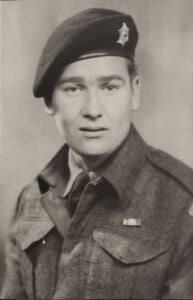
Guardsman Cecil Wentworth Brown
“He should have had a VC”
This essay was based on an Ottawa Citizen newspaper article published on 13 June 1945
“Four Guardsmen proud of the tradition of ‘buttons two by two’
came home last night to be honored by the sergeants of the 2nd Battalion and their former comrades in the 1st Battalion in an extra mural celebrations held in the GGFG sergeants’ mess with the permission of Lt-Col P. Hannaford, officer commanding the 2nd Battalion. Welcomed by the colonel and the toast of the sergeants were: Cpl L. Pauze, 362 Friel street; Gdsm W.E. Webster, Ottawa; Cpl Walter George Simpson, 21 James street; and Gdsm. C. Brown, 439 Sunnyside avenue, captured at Dieppe and the first guardsmen to become prisoners of the enemy.
Cpl Simpson paid a warm tribute to Gdsm. Brown, only 19 years old. ‘he should have had a VC’ he declared. ‘I was in action with him at Dieppe. Brown’s truck was hit by a bomb which passed completely through his vehicle right over his knees. It failed to explode and then it came into our truck, the second in line. Then it let go. I got part of it in the face and right breast. But Brown kept carrying on with a grin on his face just pushing ahead and it was great inspiration to our boys. And believe me we needed it for we were blocked in many ways by sea walls and road blocks even after we got away from the beach blocks. When things really got going and we had a bridge blown behind us and were trapped, up there in No. 1 truck was boy Brown, still with a big smile on his face. You or nobody else will ever know what that meant to us right then. But I’ll tell you that is the kind of a boy who ought to have a VC. He was worth a half a regiment to us.
Machine Gun Hail. ‘We fought our way back through a hail of machine gun fire but finally it was of no use and we all became prisoners of the Huns. If things had gone right this probably might have been the start of the second front invasion but it just didn’t work so that was that. Brown went to camp with the rest of us as prisoners of war. But I’ll tell you right now if I was in a position to recommend him for a VC, instead of just a corporal, it would have been done. Forget the rest [of] us. But that Brown is a real soldier.
The reporter was unable to find Guardsman Brown who had slipped out of the mess while his comrades were offering him a tribute which, earned in battle, was apparently well deserved.”
To put the story in context it is important to remember the mobilization of the Regiment in 1940, training in Canada for two years followed by its conversion to tanks and becoming the 21st Canadian Armoured Regiment (G.G.F.G.) where it trained in England for another two years before landing in Normandy on 24 July 1944.
Brown’s story is the story of the Regiment and common to many Ottawa families as noted in the Evening Citizen from 1942, “Guardsmen Harry and Cecil Brown, two of the four sons of Mr. and Mrs. Edwin Brown of 439 Sunnyside Avenue, think the British Isles are swell. They enlisted together and arrived in Britain last month and letters home are filled with their enthusiasm for the country and the people. Both boys mentioned the shortage of cigarettes over there. And reminded the family to keep them coming. Harry is 27 and Cecil is 21. They enlisted in the 21st Canadian Armoured Regiment of the Governor General’s Foot Guards two years ago.”
After landing in Normandy at the end of July 1944 the first month of the Regiment was the baptism of fire protecting the eastern-flank of the American build-up near Caen followed by moving into Falaise.
By the end of August the German defences were collapsing and they were in retreat. 21 Canadian Armoured Regiment, as part of the 4th Canadian Armoured Division was in the Centre with the 3rd Division on the Left and the Polish Division on the Right as they moved across the Somme River on 3 September, established a harbour for two days on the high ground east of Abbeville and then pressed forward to the Belgium border. Movement was swift and grueling as they travelled roughly 500km in just over a month bypassing enemy pockets (such as the port of Dunkirk) to disrupt and break the will of the German Forces. The Regimental history of 1948 describes what this meant to the supply lines, “…the unhappy task of moving their columns of un-armoured vehicles through territory in which large pockets of enemy still held out. On September 8th the ration clerk, L/Cpl Simpson, in a truck driven by Gdsm Morgan, and the mail clerk, L/Cpl Pauze, in a truck driven by Gdsm C. Brown, set out for the ration point to collect the day’s supplies. The route was badly signed and the trucks inadvertently drove to the outskirts of Bergues (about 16km from the hq). Here they found the road blocked by a blown bridge and as they attempted to turn around a curtain of mortar and machine gun fire was brought down. Abandoning the vehicles they were immediately surrounded by a platoon of enemy infantry and the entire party was taken prisoner, L/Cpl Simpson receiving minor wounds. The mail truck later was recovered, and while the parcels it carried were missing, the letters were still there. Curiously enough, all the stamps were cut off the envelopes, though the letters inside were undisturbed. Taken to Bergues the party was joined by Sgt. Stunden, who had been captured the previous day.”

The War Diary for September has only one small paragraph “Great concern was shown over the missing of our two supply lorries, carrying the ration clerk and our postal orderly. So far nothing had been heard of in regards to their whereabouts after being absent for over 24 hours.”
The parents of Guardsman Brown learned that their youngest son was missing on 27 September 1944. “Word has been received by Mr. and Mrs Edwin Brown, that their son, Gdsm Cecil W. Brown, 23, has been missing overseas since September 8.” It would be another six months before the family would learn that he was alive and a prisoner of war. “Reported Prisoner. Gdsm Cecil W. Brown, aged 23, who was listed as missing last September while serving overseas with the GGFG’s, is now reported to be a Prisoner of War. One of five members of his family in the services, Gdsm. Brown went overseas in October 1942. One brother is in Italy, and a sister is a CWAC corporal stationed in Ottawa.”
All of the families waited with fear and dread when they received the memorandum that their family members were missing. Imagine waiting six months to learn that they were prisoners of war and then another six months to learn that they were free and on the way home! “2 Ottawa Soldiers, … Now Reported Free. Two Ottawa … men are officially known to be liberated from enemy prison camps, Defence Headquarters announced yesterday. They are Gdsm Cecil Brown, 4, L.Cpl George W. Simpson. … Cpl Simpson was held for more than seven months in a German concentration camp. A member of the GGFG, Cpl Simpson has been overseas since October 1942 as a Transport Driver. Prior to the outbreak of the war he was employed by an optical company here.”
After returning to Ottawa Guardsman Brown met Irene Miller on a blind date in Ottawa and they married in June 1946. He made the Canadian military his career retiring in 1971 at Ottawa. Upon retirement he moved to Winnipeg MB & worked briefly with Canadian Corps Of Commissionaires. He had two sons with Irene Joan Miller between 1947 and 1954. He died on September 20, 2003, in Winnipeg, Manitoba, at the age of 82.
Cpl Phil Pauze who joined the GGFG in 1930 was known for skills as a hockey player on the amateur circuit. He signed up for active duty in 1939 and in 1942 went overseas as a transport driver and was eventually assigned the task of postal clerk. He was released as part of a prisoner exchange like his comrades. He remained an active member of the GGFG after the war retiring as a Sergeant in 1957 although he remained with the Association well into the 1960s. He married Vivian Cunningham in 1948 and spent their lives together until he passed in 2006 at the age of 86.
Cpl Simpson joined the GGFG in 1933 and was also part of the hockey team. He continued to serve in the Regiment on his return retiring in 1951. He married Edith Prentice on 3 September 1945. He passed away on in Renfrew on 8 March 1998 at the age of 82; his wife of the time was Rose Yantha.
An article in the Evening Citizen highlighted that Pauze and Simpson had the strange relationship of doing everything on the same day: joining for overseas duty with the GGFG, travelling overseas, being awarded the efficiency decoration on the same day, being captured together, liberated and returning to Canada. They both were accepted into the Civil Service and later joined the 2nd Bn, GGFG on the same day.
Gdsm Thomas Alban Morgan was the driver with Cpl Simpson and not mentioned in the reunion at the Sergeants Mess. He was taken prisoner and released with the others when liberated by the American military. He arrived in England in late April 1945. He was married, at the age of 26, prior to serving overseas to Marie Constance Veladie Desormeaux on 25 Oct 1935; his occupation was monument designer. Marie filed for divorce in 1949 from Detroit where she had been living with her brother since 1937. It is not clear whether the divorce was actually carried out as all future references in the newspapers mention them as husband and wife. Morgan’s father, Sergeant Owen Morgan served in the GGFG until his untimely death from an automobile accident in 1930 at the age of 46. He served in the Great War with the Iron Second where he was wounded along the Ypres salient on 23 Apr 1915. At the time of his death he was a member of the money order department of the Post Office Department.
The story of the four Guards who survived as Prisoners of War in the Second World War provide an interesting snapshot into our past and remind everyone of the importance of our support staff.