

The parade begins at the Cartier Square Drill Hall with the Drum Major, followed by the band, an officer carrying the Regimental Colours, the old guard, and finally the two divisions of the ‘new guard’. Turning North onto Queen Elizabeth Dr., the parade continues underneath the Laurier Ave. bridge and then turns left onto the ramp leading onto Laurier Avenue (Ottawa). The parade then continues with a right turn onto Elgin St, then ‘wheels’ onto Wellington before the parade arrives on Parliament Hill precisely at 10:00am.
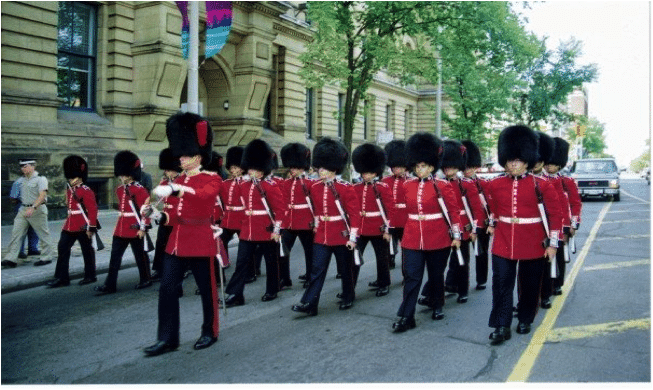
The parade marches onto the east lawn of Parliament, with the band centered at the northernmost edge of the lawn and facing south. The old guard marches to the west side of the east lawn and faces the east block, while the new guard marches to the east side of the lawn and faces west towards the old guard. After the old and new guards are formed from three ranks into two, and independently dressed off for proper alignment the two sergeants of the guard – commanders of the two divisions of new guard – advance to be inspected by the company sergeant-major. Following inspection, the number two division sergeant marches to his position while the number one division sergeant stands still. The new guard is then given the order “Get on parade”, at which point they advance to the tune of “The British Grenadiers” from the band, and form up dressed off the sergeants of the guard. The new guard’s persons and weapons are inspected by the company commander, and they are stood at ease.
Following the inspection of the new guard, the old guard is inspected. After this inspection, the sergeants of the guard and division seconds in command are ordered to ‘take post’- the sergeant of the guard marches from the right flank to directly behind the guard, while the second in command marches from the left flank to the right. The parade is then called to the present arms for the marching on of the regimental colours. With the colours marched on, the new guard advances at the slow march, ceremonially ‘taking up the ground’ from the old guard. The old guard and new guard salute each other at present arms, and the national anthem O Canada is played. Following this, the old guard commander presents the ceremonial key to Rideau Hall to the new guard commander. The parade is then formed into three ranks and marched off at the slow march, transitioning into the quick march. The order of march differs only in that the old guard is now at the rear, instead of between the band and new guard.
Sentry Duty
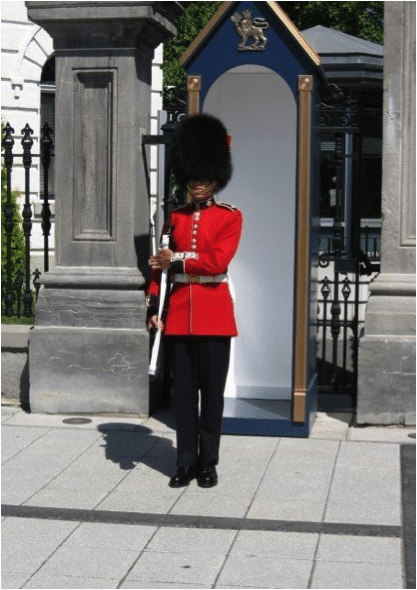
The other highly visible public duty of the Ceremonial Guard is sentry duty at Rideau Hall. The sentries are ceremonial in nature only and do not generally perform actual guard duty, however all are trained military personnel and procedures and orders do exist for the Ceremonial Guard to adopt an armed night guard of Rideau Hall should sufficient security threat arise.
The sentries are posted daily from 9:00AM EST to 5:00PM EST, every hour on the hour. At 9:00 AM the posting corporal – generally a corporal from the junior leadership but sometimes a corporal from the ranks – marches out accompanied by the four sentries, two escorts, and a bagpiper. The corporal, sentries, and escorts are all dressed in full scarlet uniforms and carry rifles with bayonets fixed. The party marches to the Sussex drive gate of Rideau Hall where the first two sentries are posted and read their duties. The party then marches to Rideau Hall itself where the two remaining sentries are posted and read their duties.
Throughout the day Rideau Hall will be visited by the Officer Commanding of the parade and the Company Sergeant-Major. They will generally elect to observe a relief of the sentries, and sometimes the Officer Commanding will take a report from the sentries on duty. The Guard Sergeant for Rideau Hall may also elect to do rounds to check on both of the sentry posts.
(Write up from Wikipedia, pics from Foot Guards)