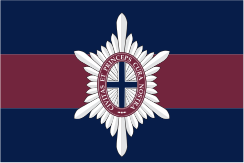
“The Lower Maas” is a Battle Honour awarded to the 21st Canadian Armoured Regiment (GGFG) for its operations in the Netherlands between the Battle of the Scheldt and the Rhineland offensive.
The Battle of the Lower MaasFollowing the clearing of the Scheldt, the Regiment moved on November 7, 1944, to the area of s’Hertogenbosch, deploying along the main highway with headquarters at Rosmalen. The campaign on the Lower Maas was characterized by the following:
• Objectives: The Regiment’s task was twofold: to protect the lines of communication from s’Hertogenbosch to Nijmegen and to contain the German forces positioned north of the River Maas.
• Tactics: The unit honed its skills in using tanks as mobile artillery. They conducted indirect shoots by day and night on targets across the river to suppress enemy shelling and patrolling. This technique became so proficient that enemy shelling practically ceased in their sector.
• Conditions: It was a period of “long cheerless days and nights passed in picqueting in the damp cold,” with troops billeted in barren barns and small rooms. Despite the harsh winter conditions, the morale remained high, and the troops formed strong bonds with the liberated Dutch civilians, often sharing their rations with the hungry local children.
• Action: While largely static, the Regiment dealt with enemy agents and saboteurs infiltrating across the river. On December 9, the Regiment supported the Lake Superior Regiment in an attack on Fort Crevecoeur, a German-held salient south of the Maas, using their tanks in an artillery role with outstanding success.
Comments?
Fill out the form below to provide any comments on the event above.