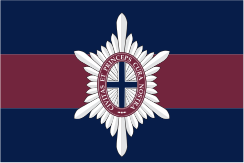

The GGFG Regimental badge was modified from the Colstream Badge (the Star of the Order of the Garter) to a six pointed star, each point representing the provinces of Canada at the time of Confederation (Ontario, Quebec, Manitoba, Nova Scotia, British Columbia and New Brunswick. The Cross for St George in the centre was changed to blue with a 1 for “Ist Battalion”. The Regimental motto, “Civitas et Princeps Cura Nostra’, was placed in the annulus. The star was surmounted by a Royal Crown and underneath a scroll bearing the words “The Governor General’s Foot Guards”.
In 1932 the Regimental badge was changed to a 6 pointed rayed star with the Cross for St. George (blue) in the centre and the Regimental motto in the annulus. A maple leaf was placed in the centre. The maple leaf, a symbol of Canada, is also representative of the maple leaf worn by the Canadian Expeditionary Forces in World War One and signifies the perpetuation by the Regiment of the 2nd Battalion, and the 77th Battalion.
Upon an annulus ensigned with the Imperial Crown a six-pointed star, bearing in the centre a roundle having thereon the figure 1872, with the initial letter of the six provinces forming the Dominion in 1872; with a spray of maple leaves on the dexter side and of roses, shamrocks and thistles on the sinister side, and below, a scroll bearing the words Governor Gen – Canada – Foot Guards
The Regimental Star
On the right sleeve of Sergeant-Major’s Tunic The Royal Arms for Canada, crest, motto, and supporters.
The following is an excerpt from a Regimental order signed by the Lieutenant Colonel Commanding on 14th May 1982:
“When the Regiment was formed the uniform and appointments approved for wear by Her Majesty Queen Victoria were those of our allied Regiment, the Coldstream Guards, with certain distinctively Canadian variations. In practice this has resulted, among other things, in the Sergeant Major wearing the large Royal Arms on bis tunic, as Chief Warrant Officers of the Regiment who do ot hold the appointment of RSM wear the small Royal Arms, our link with the Coldstrean is one of which the Regiment is most proud, indeed, many of our privileges and traditions derive from this link and we will continue to foster it appropriately. At the same time it is considered desirable to inpress upon all ranks (and the public, in whose eye we are frequently seen and to many of whom we are representative of the Canadian Armed Forces) that the Regiment is Canadian, with its own distinguished
bistory of service to Canada and the Crown. In keeping with these sentiments of Canadian identity linked closely with loyalty to the Crown and its Canadian representative, [ have secured the authority of the Regimental Senate to display on the Sergeant Major’s tunic the large Royal Arms for Canada, as bis badge of rank and office. Chief Warrant Officers of the Regiment not bolding the appointment of RSM will wear the small Royal Arms for Canada”’
A Maple Leaf
On right sleeve of Tunic, Patrol and Mess jackets by Master Warrant Officers and Colour Sergeants
The Colour Badge
Similar in design to the Colour Badge worn by the Coldstream Guards. The badge displays the cypher used by the incumbent Governor General.
The Regimental Star, superscribed Governor General’s Foot Guards with a stylized Canadian Maple leaf in base.
The Regimental Star.
The Officers’ large cap-star, chased.
The Regimental Star, and the Battle Honours
The Royal Arms for Canada, crest, motto, and supporters, superscribed Governor General’s Foot Guards. On either side of the supporters, the Queen’s and Regimental Colours. Beneath the Royal Arms, on the bass drum the No. 1 Company badge, and on the tenor and side drums the Regimental Star. Beneath each star, a beaver couchant as in base of the Regimental Colour. On either side of the Colours on the tenor and side drums, and surrounding the Star and the beaver on the bass drum, those Battle Honours of the Regiment which are borne on the Colours.
On the top, the Imperial Crown, Or. Round the head, those Battle Honours of the Regiment which are borne on the Colours, Argent, the whole in relief. on the reverse of the head, within a wreath of laurel, the Royal Cypher, Argent, the whole in relief. on the reverse of the head, the Regimental Star proper, superscribed GOVERNOR GENERALs FOOT GUARDS, Argent, the whole
in relief. Beneath the ferrule on the reverse, a brass plaque bearing the inscription Presented by the Coldstream Guards 1 July 1972
On the top, the Regimental Star.
The No 1 Company (the Association) badge proper, surmounted by the Imperial Crown. On a wreath of laurel those Battle Honours of the Regiment which are borne on the Colours. In the centre of the wreath of laurels, the beaver as in base of the Regimental Colour. In base, the No. 2 Company badge, proper.
The Star of the order of the Garter, an eight pointed silver star with the Red Cross for St. George in the centre surrounded by a red annulus the royal motto “Honi Soit Qui Mal Y Pense”, translated as Evil to Him Who Evil Thinks. It is also worn as the collar badge of the Coldstream Guards.
Officers’ Scarlet: The Regimental Star (large)
Officers’ White: The Regimental Star (small)
Senior Non-Commissioned Officers’: The Regimental Star (small)
The first Cap Badge was a six pointed star with the initials of the provinces at the time of Confederation as listed above. Officers generally wore a cloth star similar to the collar badge worn on full dress, on both the Forage Cap and the various field caps. All other ranks wore a brass badge (similar to the collar badge worn on service dress).
In 1931 the Cap Star reflected the Regimental Badge, although the maple leaf was not evident. This is believed to be the result of the difficulty of manufacturing a proper maple leaf on the star. Different sized cap stars were taken into use at this time. Officers and Senior Warrant Officers wore a silver cap badge similar to the cap badge worn prior to 1932, and Colour Sergeant’s and below adopted the cap badge similar to the one that is worn today, although the cross was cut out.
In 1956 the officer’s adopted the large cap star that is now worn on the Forage Cap.
In’silver, a six pointed star of thirty rays surcharged with an oval, a blue cross in the oval; around the oval a red annulus and within the annulus the Regimental motto with a stylized period at the bottom.
The six points of the star are representative of the six Provinces which formed the Confederation at the time that the Regiment was raised.
There are no dimensions for the star; it is reproduced to scale on Regimental appointments and artifacts as required.
Officers’ Large Cap-Star
Adopted for use in 1956 the design of the star is as follows: In silver, a six pointed star of thirty rays surcharged with an oval medallion, with a blue enamelled cross in the oval; around the red enamelled annulus the Regimental motto in silver with the date 1872 at the bottom.
Extreme height 23/16 inches
Extreme width 17/16inch
Dimensions of Cross:
Extreme height 15/32 inch
Extreme width ~ 11/32 inch
In white metal, a six pointed star of thirty rays surcharged with an oval medallion, with a blue enamelled cross in the oval; around the red enamelled garter the name of the Regiment abbreviated Gov Gen’s Foot Guards in white metal
Extreme height 17/16 inch
Extreme width 1 inch
Dimensions of Cross:
Extreme height 13/32 inch
Extreme width ~ !/4 inch
In silver, a six pointed star of thirty rays surcharged with an oval garter with a blue cross in the oval; around the garter the motto of the Regiment. The cross and the garter are pierced, upon a blue background.
Extreme height 13/16 inch
Extreme width 13/8 inch
Dimensions of Cross:
Extreme height /8 inch
Extreme width ~ 3/g inch
In white metal, a six pointed star of thirty rays surcharged with an oval medallion with a blue cross in the oval; around the medallion the Regimental motto in relief.
Extreme height 13/16 inch
Extreme width ~ 13/8 inch
Dimensions of Cross:
Extreme height /8 inch
Extreme width ~ 3/s inch
The uniform of the GGFG is based upon the uniform worn by her allied Regiment, the Coldstream Guards with specific Canadian distinctions. The Full Dress uniform has remained virtually unchanged since 1872.
The Bearskin was taken as trophy when the 1st Regiment of Foot Guards defeated the grenadier battalions of Napoleon’s Old Guard at Waterloo. In 1815 the 1st Regiment was designated as the Grenadier Regiment of Foot Guards, and wore the bearskin cap, which previously was worn only by Grenadier companies in the British Army. The Coldstream Guards adopted the bearskin cap in 1830-34 with a red plume on the right side as a quick method of identification.
The Bearskin cap is worn primarily for two reasons, it adds height to the Guardsman which intimidates the enemy, and the smell of bear fur unsettles horses and can cause them to unseat their rider.
The GGFG have worn the bearskin since 1872. The red plume is worn on the left side to denote the difference between the Coldstream and the GGFG.
The first Forage Cap was a midnight blue fabric cap with a cardboard liner and no peak. A white band was adopted at the time that it was taken into wear, identical to the Coldstream Guards. The white band is a custom that pre-dates the red plume and it is not known, in the Coldstream Guards, why the white band was adopted, or why the red plume was adopted for wear on the bearskin.
A peak was added to the Forage Cap for Segeant’s and above in the 1880s.
The white band was replaced with Gold lace. By the turn of the century the Forage Cap for Non-Commissioned Officers and men resembled the same as today, although a white cover was worn over the cap to keep it from being damaged.
The Forage Cap for Officers is Midnight blue cloth, Coldstream Guards pattern with embroidered gold peak and plain black chinstrap, a band of black mohair braid 1.5 inches wide, and 20 ligne buttons on either side. This cap was adopted at the turn of the century for wear with undress uniforms. In 1931 it was adopted for wear with service dress, and was officially recognized by the Chairman of the National Defence Clothing and Dress Committee on 5 Nov 1986.
In 1931 the Regimental Dress Committee instituted changes to the peak of the Non-Commissioned Officers and men Forage Cap to denote rank.
Today the rank is as follows:
Chief Warrant Officer: five rows of narrow gold Russia braid on lower edge of peak
Master Warrant Officer: four rows of narrow gold Russia braid on lower edge of peak
Colour Sergeants: brass binding around edge plus two brass strips
Band Colour Sergeants: three rows of narrow gold Russia braid on lower edge of peak
Sergeants: as for Colour Sergeants.
Band Sergeants: as for Band Colour Sergeants.
Master Corporals: brass binding around edge plus one brass strip.
Band Master Corporals: two rows of narrow gold Russia braid on lower edge of peak.
Corporals and Guardsmen: Brass binding around edge only.
Band Corporals and Musicians: One row of narrow gold russia braid on edge of peak.
Fill out the form below to provide any missing context from the above article.