
Civil Service Rifle Corps is Formed
GGFG Officially Formed

Nile Expedition

NorthWest Resistance

South African War
First World War

The 2nd Canadian Battalion

The 77th Battalion, Canadian Expeditionary Force

Parliament Hill Fire

Inter-War Years

Second World War
GGFG is mobilized and later becomes the 21st Canadian Armoured Regiment (G.G.F.G.), landing in France in 1944. A second battalion serves in Ottawa.

Mobilization and Conversion to Armour
Following the outbreak of war, the Regiment was mobilized in June 1940 as an infantry battalion. They trained in Ottawa at Lansdowne Park, then moved to Camp Borden, Toronto, Valcartier, and Sussex, New Brunswick. In January 1942, the unit underwent a major transformation, converting from infantry to an armoured role and becoming the 21st Canadian Armoured Regiment (G.G.F.G.). They subsequently moved to Debert, Nova Scotia, to begin specialized tank training.

Training and Movement to England
On September 23, 1942, the Regiment left Debert and sailed from Halifax on the Pasteur, arriving in England to begin intensive armoured training. Stationed at locations such as Aldershot and Brighton, they trained on Ram and Sherman tanks. During this period, they were inspected by high-ranking officials, including the Prime Minister and General Eisenhower, as they prepared for the invasion of the continent.

The Campaign in North West Europe
The Regiment landed in France in July 1944 and fought through Normandy (Caen and Falaise), Belgium, and Holland, ending the campaign in Germany in May 1945. They engaged in fierce battles against Tiger tanks and anti-tank guns. One specific tank, "Forceful III," became famous as the only tank of the original 60 issued to the Regiment to fight through the entire campaign from France to Germany without being put out of action.

Homecoming of the Regiment
On January 16, 1946, the 1st Battalion arrived home in Ottawa to a tremendous welcome. On a bitterly cold evening, the Regiment marched from the station past the National War Memorial to Parliament Hill and finally to Lansdowne Park. During the dismissal ceremony, the Colours, which had been safeguarded by the 2nd (Reserve) Battalion in Ottawa during the war, were formally returned to the active unit.

Formation of the Foot Guards Association
The Association was formed to maintain the friendships forged during the war and to assist returning personnel with rehabilitation. The first meeting was held in the Bandroom with approximately 100 to 150 members in attendance.

Coronation Trooping the Colour
On June 2, 1953, the Regiment Trooped the Colour on Parliament Hill to celebrate the coronation of Her Majesty Queen Elizabeth II. This was the last time the Regiment paraded alone for a Trooping, as subsequent ceremonies were held in conjunction with the Canadian Grenadier Guards.

Opening of the Regimental Museum
After years of planning and collecting artifacts, the Regimental Historical Museum was officially opened in the Drill Hall on September 29, 1956, coinciding with the annual Caen-Falaise dinner. Captain W.H. Lanceley was the first curator.

Commencement of Public Duties & New Colours
In the summer of 1959, the Regiment was authorized to mount the Ceremonial Guard on Parliament Hill daily. The first Guard at Government House was mounted on July 2, 1959. On September 13, 1959, His Excellency Governor General Vincent Massey presented new Colours to the Regiment at Rideau Hall. The old Colours were trooped for the last time and later laid up in Christ Church Cathedral.

Regimental Centennial Celebrations
The Regiment celebrated its 100th anniversary with a Centennial Tattoo at the Civic Centre and the presentation of new Colours by Governor General Roland Michener on Parliament Hill on July 1, 1972.

First Women in the Regiment
In June 1972, the Governor General's Foot Guards welcomed its first cohort of women through the Student Summer Employment Program. Starting with a group of ten, often training without proper gear or standard uniforms.

International Missions during the Cold War
During this period, the Regiment did not deploy overseas as a complete unit; however, individual officers and soldiers augmented Regular Force units or were seconded for specific United Nations and NATO duties.
- UNMOGIP (Kashmir) 1950 to 1995
- UNEF I (Gaza/Egypt) 1957-1959
- SNOWGOOSE (Cyprus) 1964 to present
- DANACA (Egypt) 1973-1979
- CALUMET (Sinai) 1985 to present

Return and Dedication of Forceful III
The Sherman tank "Forceful III," which served with the Regiment in Europe, was recovered from Camp Borden and dedicated as a permanent memorial outside the Drill Hall on September 29, 1985. In 2004, Forceful was moved inside the newly constructed Canadian War Museum where it remains today.
International Missions in the 90's
During this period, the Regiment did not deploy overseas as a complete unit; however, individual officers and soldiers augmented Regular Force units or were seconded for specific United Nations and NATO duties.
- HARMONY (Croatia) 1992-1995
- PALLADIUM (Bosnia) 1995-2004
Domestic response – Manitoba Floods
Op ASSISTANCE (1997) In the spring of 1997, the Regiment deployed personnel to support the relief efforts for the Red River Valley flood victims in Manitoba. Five soldiers deployed with the 1st Battalion, The Royal Canadian Regiment, to assist in the operation.
Domestic response – Ice Storm
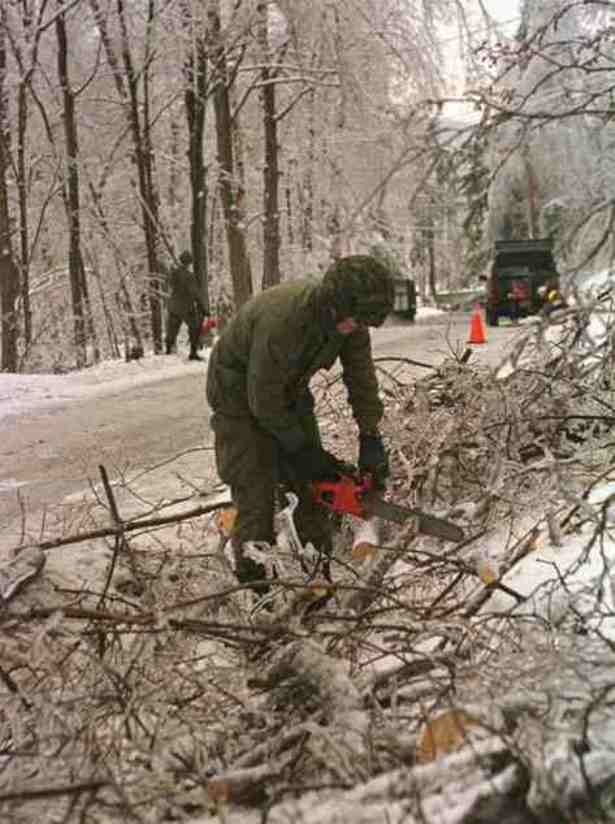
Ice Storm — Op RECUPERATION On January 9, 1998, the Regiment was mobilized to assist during the massive ice storm that devastated Eastern Ontario and Quebec. This was the largest mobilization of the unit since World War II, with over 100 soldiers deploying to communities such as Casselman, Finch, Crysler, and Avonmore. The troops cleared fallen trees for Hydro crews, went door-to-door to check on residents, and provided essential supplies like heaters and fuel.

International Missions in the 2000's
During this period, the Regiment did not deploy overseas as a complete unit; however, individual officers and soldiers augmented Regular Force units or were seconded for specific United Nations and NATO duties.
- ADDITION (Ethiopia/Eritrea) 2000-2008
- SCULPTURE (Sierra Leone) 2000-present
- ATHENA (Afghanistan) 2001-2011
- SAFARI (Sudan) 2004-2005

The Afghanistan War
The Governor General's Foot Guards contributed significantly to the mission in Afghanistan, deploying officers and soldiers to both Kabul and Kandahar as augmentees to Regular Force battle groups throughout the campaign. This commitment, which earned the Regiment the Theatre Honour "Afghanistan", saw members serving in diverse roles ranging from infantry operations and psychological operations to close protection and training the Afghan National Army. Notably, Cpl John Makela was awarded the Medal of Military Valour for preventing a suicide bomber attack on a convoy in October 2006.

International Missions in the 2010's
During this period, the Regiment did not deploy overseas as a complete unit; however, individual officers and soldiers augmented Regular Force units or were seconded for specific United Nations and NATO duties.
- SOPRANO (South Sudan) 2011-present
- IMPACT (Iraq) 2014-present
- UNIFIER (Ukraine/UK/Poland/Latvia) 2015-present
- REASSURANCE (Poland/Latvia) 2017-present

Domestic response – Ottawa & Outaouais floods
In May 2017 and 2018, members of the Regiment participated in Operation LENTUS, the Canadian Armed Forces response to widespread flooding in the Ottawa and Montreal regions. The soldiers performed exceptionally well assisting civil authorities and helping communities specifically in the Outaouais region.
Domestic response – COVID-19 Pandemic
COVID-19 Pandemic — Op LASER. Beginning in March 2020, the Regiment prepared to support the Canadian Armed Forces response to the COVID-19 pandemic. Over the course of the summer, the Regiment contributed 76 members to Op LASER, which included providing military support to Long Term Care Facilities.
International Missions in the 2020's
During this period, the Regiment did not deploy overseas as a complete unit; however, individual officers and soldiers augmented Regular Force units or were seconded for specific United Nations and NATO duties.
- IMPACT (Jordan) 2021-2024

The Regiment's 150th anniversary
In 2022, the Governor General's Foot Guards celebrated their 150th anniversary through a comprehensive program divided into celebratory and charitable campaigns led by HCol Bryan Brulotte and Executive Director LCol (Ret'd) Fran Chilton-Mackay. Key events included a Freedom of the City parade, the rededication of Regimental Colours at Ottawa City Hall, a Homecoming Gala Ball, and a historic plan to mount the ceremonial guard at Buckingham Palace in London. The anniversary also successfully raised funds to address veteran homelessness and heritage projects, leading to the establishment of the GGFG Youth Achievement Awards